
We believe water management practices represent the main challenge to mitigate the risk on water’s availability. How to assess the impact of such practices? How to qualify an impactful or impactless practice? How to promote the best practices but still prevent any rebound effect at a watershed scale?
Watershift develops and deploys innovative and ready-to-use tools to support farming companies and entrepreneurs willing to move towards more water-efficient practices.
Impact-driven
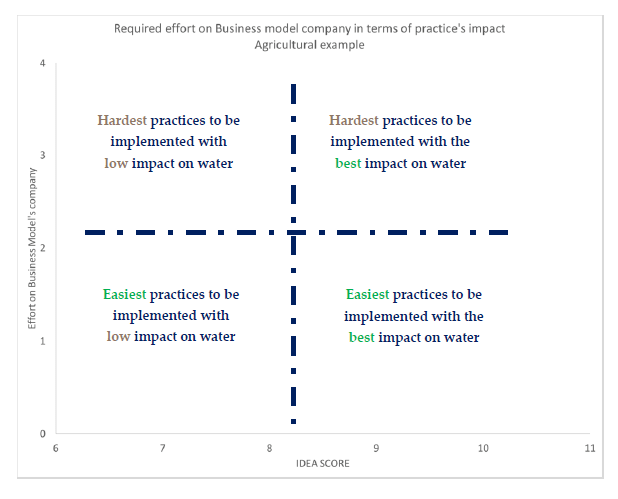
Based on our key findings, we decided to combine both impact assessment results and business models’ analysis for each identified best practices. It results in a best practices typology based on their impact on water resources and their easiness to be implemented :
- From the water resources’ status and flows, the IDEA Score1 quantifies the practices’ impact on water resources. It illustrates the interaction between the practice and the water resource. It is the x-axis scale: the higher the IDEA Score, the better the impact on water resources, and thus, the more the practice is placed on the right side of the figure.
- From the companies’ side, the number of business model’s components concerned by practices’ implementation demonstrates the practices’ impact on business models. It illustrates the effort that the company needs to do to implement those practices. It is the y-axis scale: the more business model’s components are concerned, the harder the practice is to be implemented and thus the more the practice is placed at the top of the figure.
1The IDEA method is developed by several French researchers specialized in sustainable agricultural practices assessment. IDEA stands for Indicateurs de Durabilité des Exploitations Agricoles (or Farm Sustainability Indicators). This is a normative approach focused on sustainable development and the three normative dimensions. From the 2000s, the IDEA method has been applied to the farming sector to bring field content about best practices in farming. The last revised version dates 2020 and chose to underline the strong sustainability approach in its conceptual framework. That is why we have inspired from the IDEA method to deepen the Watershift’s impact-based approach.
High-impact practices are strongly correlated with business models and companies’ economic choices. A presentation of sustainable alternative practices alone is not enough to enable their implementation and effectively reduce water’s consumption. Therefore, adapted economic and financial suggestions are essential to trigger a practices’ change.
Systemic and sustainable shift
We believe transformation may be stimulated by adapted investment means. It can be used as a lever to facilitate transition towards more sustainable practices. This is why Watershift also explores the potential for a financing mechanism to support the transition to water-sustainable sectors in the Mediterranean basin.
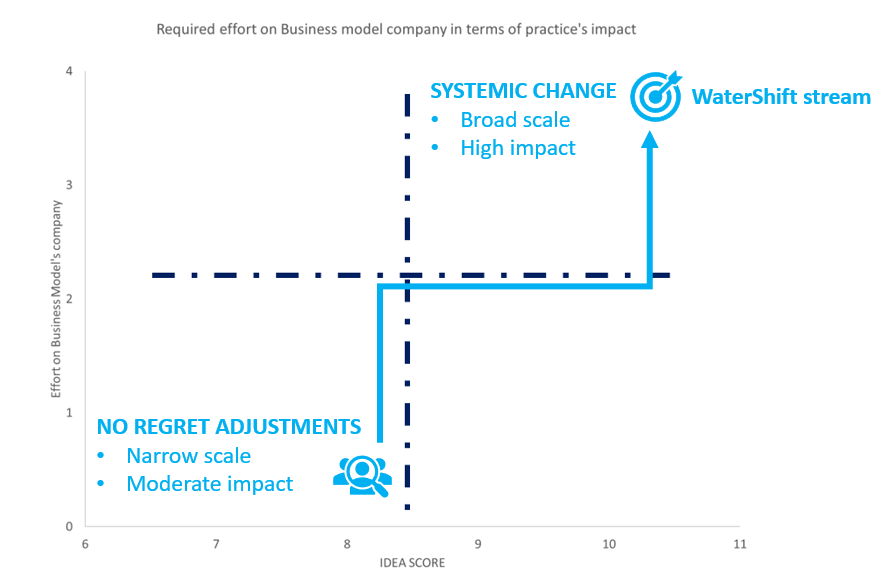
The challenge is to build a high-performance ecosystem of stakeholders by financing and increasing the skills of a few high-potential farming organisations.
 Watershift